Present Tense Worksheets

Handouts Online has a fantastic range of worksheet for the Present Simple and Present Continuous tenses.

Unlock Access to Hundreds of Premium Worksheets!

Our extensive collection of high-quality worksheets will help you teach more effectively and engage your students.

Premium Worksheets
Talking About Where You Live (part 1)
Talking About Where You Live (part 2)
Talking About Where You Live (part 3)

Talking About Where You Live

Structure: Conversational Expressions
Time: 30+ min
Level: Elementary +

It's one of the most basic conversations your elementary-level students need to be confident with. However, it can be fraught with difficulty!

Your students will become confident with questions including:

  • Where do you live?
  • How long have you lived there?
  • Do you like [London]?
  • What's there to do in [London]?
  • ...and more

This worksheet has a gap-fill conversation, follow-up exercises and role-play cards.
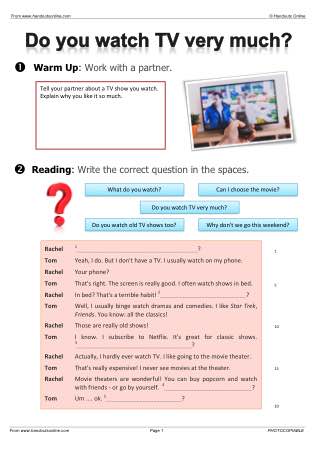
Do you watch TV very much?

Do you watch TV very much?

Structure: Adverbs of Frequency / Present Simple
Time: 60+ min
Level: Elementary

This worksheet combines a review of adverbs of frequency (often, never, occasionally etc.) with a conversation about TV viewing habits.

It's also a great way to review Present Simple questions and build some up-to-date vocabulary.

Vocabulary covered includes binge watch, dramas, comedies, classics, subscribe and more.

Following the lead-in, there is a question-gap-fill reading, vocabulary-building exercises, grammar analysis and discussion.

This worksheet is great for elementary-level students looking to improve their confidence.

What kind of food do you like? (part 1)
What kind of food do you like? (part 2)
What kind of food do you like? (part 3)

What kind of food do you like?

Structure: Likes and Dislikes
Time: 45 min
Level: Elementary
Likes and dislikes is a great topic for lower-level students, as it gives them the opportunity to personalize the language they are learning. This worksheet looks at some common expressions associated with likes and dislikes. This includes: * I'm a big fan of... * I'm really into * I can't stand * I don't mind There is a conversation, some practice exercises and role-play. The lesson finishes off with a class survey.
Spot the Errors (part 1)
Spot the Errors (part 2)
Spot the Errors (part 3)

Spot the Errors

Structure: Mixed Grammar
Time: 20 min
Level: Elementary or Pre-Intermediate

Do your students make the same endless mistakes with the most basic structures? Have your revenge! This error-correction worksheet deals with Present Simple, Past Simple, Preposition and that 'interested / interesting' error which seems impossible to fix.

Ideal for Elementary and Intermediate students who you've been teaching for some time...

Action Flashcards (Small) (part 1)
Action Flashcards (Small) (part 2)
Action Flashcards (Small) (part 3)

Action Flashcards (Small)

Structure: Verbs and Tenses
Time: 30 min
Level: Various

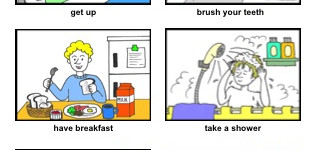
There are so many ways to use these flashcards!

You can use them to teach the present simple and present continuous.

e.g. What does [James] do every morning? / What is James doing?

or What did [James] do yesterday?

They also teach lots of common vocabulary and collocations that your students need to learn. Why not give them a set of cards to learn at home?

The cards come in a two-per-page and six-per-page format in both black and white and colour.
Action Flashcards (Large) (part 1)
Action Flashcards (Large) (part 2)
Action Flashcards (Large) (part 3)

Action Flashcards (Large)

Structure: Verbs and Tenses
Time: 30 min
Level: Various

There are so many ways to use these flashcards!

You can use them to teach the present simple and present continuous.

e.g. What does [James] do every morning? / What is James doing?

or What did [James] do yesterday?

They also teach lots of common vocabulary and collocations that your students need to learn. Why not give them a set of cards to learn at home?

The cards come in a two-per-page and six-per-page format in both black and white and colour.
Your Free Time (part 1)
Your Free Time (part 2)
Your Free Time (part 3)

Your Free Time

Structure: Present Simple
Time: 45 min
Level: Elementary
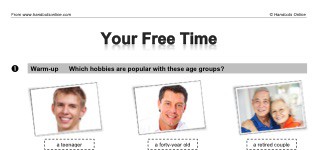
Elementary students need lots of practice of the Present Simple! This worksheet looks at a simple conversation about hobbies, and gives your class the opportunity personalize the language by asking and answering questions using the Present Simple. There is an opening speculation exercise, followed by a gap-fill conversation. Your students will then look at some common hobby collocations. The lesson rounds off with multiple conversations, as your students ask their classmates questions about hobbies, using the Present Simple. This lesson will help your elementary students become much more confident with their question and answering skills.
What are you reading? (part 1)
What are you reading? (part 2)
What are you reading? (part 3)

What are you reading?

Structure: Present Simple v Present Continuous
Time: 40 min
Level: Elementary
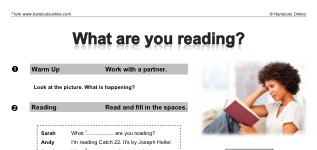
Students can find the difference between 'I am reading' and 'I read' tough to master. This worksheet will definitely help! There is a conversation showing the difference between the two forms. This is followed by comprehension questions, personalisation work and a mixing activity to get your class using the language actively. This worksheet is written for elementary-level students.