Intermediate-Level Worksheets

This is a detailed list of our intermediate-level worksheets. It's easy to adjust our materials to make them easier or more difficult. If you're looking for a specific worksheet, our search engine will help you pinpoint it in seconds!

Unlock Access to Hundreds of Premium Worksheets!

Our extensive collection of high-quality worksheets will help you teach more effectively and engage your students.

Premium Worksheets
New Words (part 1)
New Words (part 2)
New Words (part 3)

New Words

Structure: Vocabulary and Discussion
Time: 60-90 min
Level: Intermediate

The English language is constantly changing, with new words coming into use. This worksheet looks at how new words are added to dictionaries.

The worksheet begins with a (not-too-serious) quiz. Can your students guess when words such as 'photobomb' and 'air-guitar' were added to the dictionary?!

This is followed by reading and vocabulary quizzes.

The lesson rounds off with a discussion on the words we use.

Have your students noticed new words coming into fashion? Are English words common in their own language? What do they think of that?

This worksheet is fun way to build reading and discussion skills, while improving vocabulary knowledge. Try it today!

Nelson Mandela (part 1)
Nelson Mandela (part 2)
Nelson Mandela (part 3)

Nelson Mandela

Structure: Past Simple Questions: Passive and Active
Time: 30+ min
Level: Intermediate

How well do your students know the story of Nelson Mandela?

This worksheet has a short gap-fill reading. It's ideal for students working in pairs.

If you're in a one-on-one lesson, the teacher can take one of the roles.

Students need to read the story and ask their partner questions in order to fill in the gaps.

The questions are both active and passive.

This worksheet is also a great way to build your students' vocabulary. It is written for intermediate-level classes.


All About 'Bring' (part 1)
All About 'Bring' (part 2)
All About 'Bring' (part 3)

All About 'Bring'

Structure: Phrasal Verbs
Time: min
Level: Intermediate
Increase your students' vocabulary knowledge with this phrasal verb worksheet! There are six phrasal verbs, all themed around 'bring. The worksheet covers: * Bring up (a child) * Bring out (a new album) * Bring down (a government) * Bring up (a subject) * Bring down (prices) * Bring back (memories) There are opening gap fill exercises followed by a caption quiz and discussion questions. This worksheet is written for intermediate-level students.
Online Auctions (Updated) (part 1)
Online Auctions (Updated) (part 2)
Online Auctions (Updated) (part 3)

Online Auctions (Updated)

Structure: Reading and Discussion
Time: 60 min
Level: Intemediate and Advanced

Online auctions are becoming big business as people search in their lofts for things of value.

This worksheet looks at the growing popularity of online auctions. There's a mini-quiz, a reading, vocabulary work and lots of discussion.

It's great for intermediate and advanced-level students.

We have added (December 2013) a new vocabulary quiz and made adjustments for a UK and USA version of this worksheet.

A Nip and Tuck (part 1)
A Nip and Tuck (part 2)
A Nip and Tuck (part 3)

A Nip and Tuck

Structure: Reading, Vocabulary and Discussion
Time: 45 min
Level: Upper-Intermediate to Advanced

How popular is cosmetic surgery in your students' home countries? Is there anything wrong with going under the knife?

This worksheet looks at the growing popularity of cosmetic surgery, including some statistics for the USA and UK.

It makes a great topic for discussion. How far should people go in order to change their appearance? Is cosmetic surgery any different to dying your hair or having teeth straightened?

This worksheet will help build vocabulary, reading and discussion skills. It is written for upper-intermediate and advanced-level classes.
Idioms by the Number (part 1)
Idioms by the Number (part 2)
Idioms by the Number (part 3)

Idioms by the Number

Structure: Idioms Themed by Numbers
Time: 45 min
Level: Intermediate +
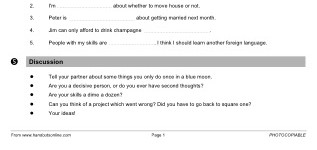
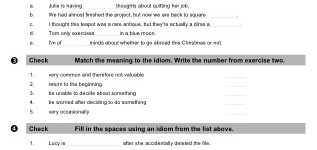
Students love to study idiomatic English, and this worksheet will teach five common expressions. Taking numbers as the theme, there are gap fill sentences to have your students try to guess the meanings from the context. This is followed by exercises recycling the language to help your students consolidate the new expressions. The lesson rounds off with discussion, with your students having the opportunity to use the idioms in context. This worksheet is written for intermediate levels and above.
Performing on Stage (part 1)
Performing on Stage (part 2)
Performing on Stage (part 3)

Performing on Stage

Structure: Conversation and Vocabulary Building
Time: 45 min
Level: Intermediate
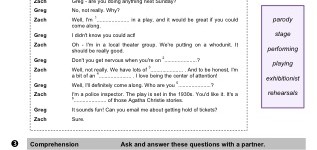
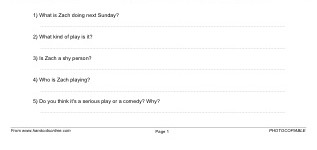
Do any of your students have experience of being on stage? Would they like to get involved in a local theater group? Do they ever go the theater to watch plays? This worksheet is based around a conversation in which someone is going to be acting in a play. There are exercises building collocation knowledge (put on a play, get hold of tickets, the story is set, come along...) which your students can then try to use in a role-play. The lesson rounds off with discussion questions. Would your students ever consider acting? Do they get nervous when speaking in front of people?
Studying a New Language (part 1)
Studying a New Language (part 2)
Studying a New Language (part 3)

Studying a New Language

Structure: Various
Time: 45 min
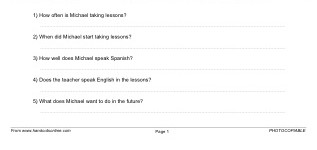
Level: Pre-Intermediate
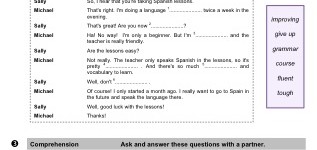
This worksheet will give your students the opportunity to learn expressions connected to language learning. There is a lead-in question, followed by a conversation about taking Spanish lessons. There are follow-up exercises looking at some common vocabulary associated with language learning, such as improve, fluent, grammar, and more. Your students will then need to personalise the language, applying it to their own situation. Do they think they are improving? What do they find most difficult about learning English? Do they enjoy your lessons?! The lesson rounds off with simple discussion practice, where students can talk more about these kinds of topics. This lesson is written for lower-intermediate level students and above.